Merchantec Capital's CEO Confidence Index

About the CEO Confidence Index

The Merchantec CEO Confidence Index is a quarterly copyright report which collates the views of CEO’s of listed, large private and multinational companies in South Africa since 2009. CEOs are key players in the market and economy and are instrumental in influencing the future of Corporate SA. Therefore, by collecting CEOs views, the CEO Confidence Index provides a leading indicator of economic and market conditions as well as insight into how South African business leaders perceive the economy going forward.

The Index is unique in that it accounts for CEO Confidence according to sectors – making a good connection to Company prospects in the various sectors.

Merchantec Capital supports the Nelson Mandela Children’s Fund

Merchantec Capital has made a commitment to donate R110 to the Nelson Mandela Children’s Fund on behalf of each CEO who completes the questionnaire. Donations will go toward the operation and development of the Nelson Mandela Children’s Hospital, which provides specialised care to South Africa’s underprivileged children. Learn more about this initiative and the beneficiary by clicking here.

Our Latest Report

CEO Confidence Index drops slightly, but 55% of CEOs back Budget Speech commitments

Q1 2026 Index falls to 46.2 amid Iran conflict and petrol price pressures, while AI and VAT reforms spark optimism in key sectors

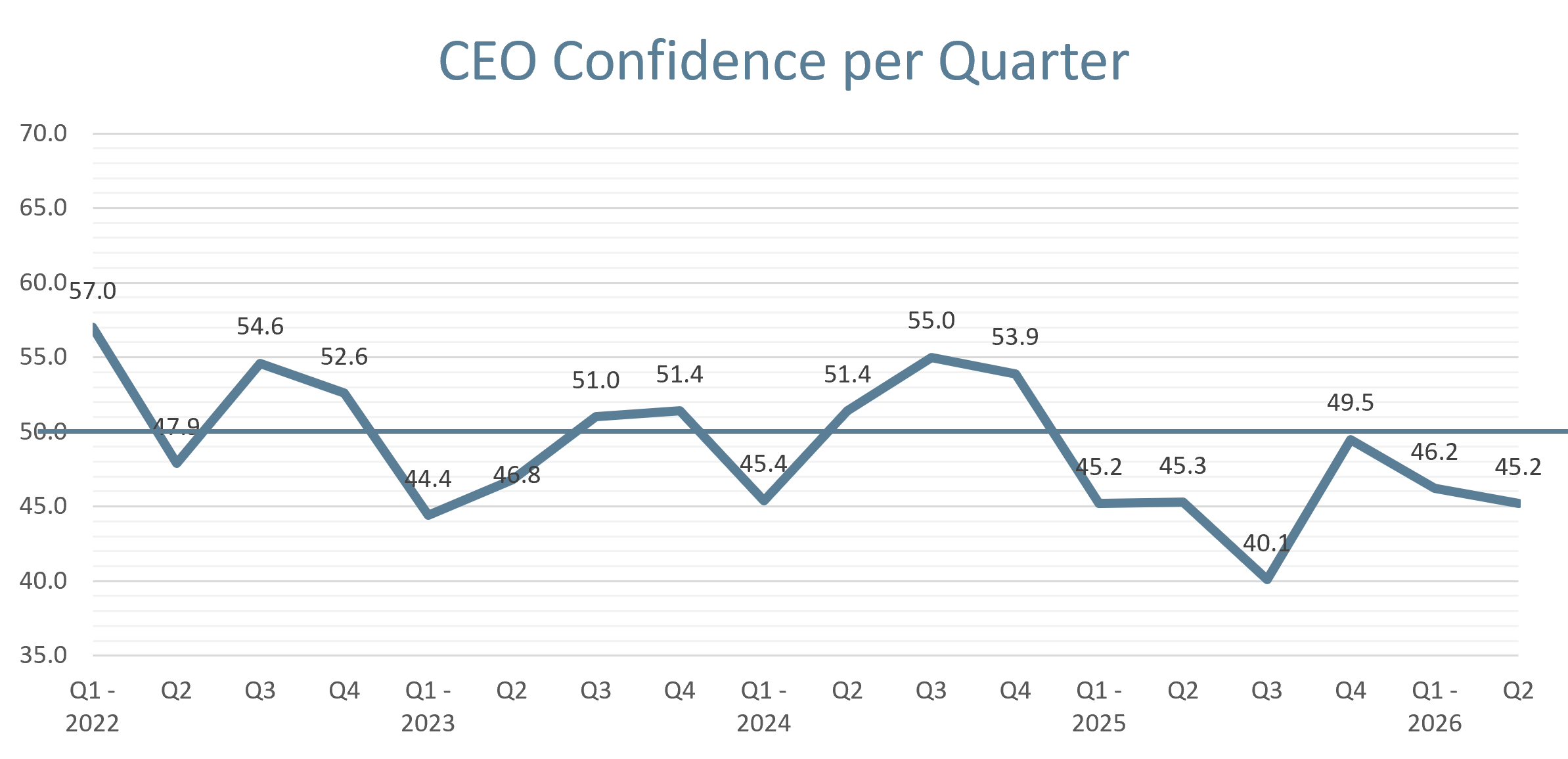
South African CEO confidence dipped to 46.2 in Q1 2026, down 3.3 points from Q4 2025’s 49.5, reflecting a cautious start to the year shaped by geopolitical uncertainty, soaring fuel costs, and scepticism around government delivery.

Yet beneath the headline decline lies a more nuanced picture: 55% of CEOs expressed confidence in the 2026 Budget Speech commitments, signalling measured optimism about fiscal discipline, VAT threshold reforms, and infrastructure pledges.

At the same time, Technology and Real Estate sectors surged on the back of AI-driven transformation and improving property fundamentals, while geopolitical fallout from the Iran conflict and spiking petrol prices cast a shadow over consumer-facing and industrial sectors. CEOs emphasised that “government promises” must now translate into visible action—particularly on energy, logistics, and regulatory simplification—if South Africa is to sustain momentum beyond cautious sentiment.

Key highlights

  • Overall CEO Confidence Index: 46.2 in Q1 2026, down 3.3 points from Q4 2025 (49.5), settling below the neutral 50 mark.
  • Budget Speech confidence: 55% of CEOs supported the 2026 Budget Speech commitments, citing VAT threshold increases (R1 million to R2.3 million), improved fiscal discipline, and infrastructure investment as positives.
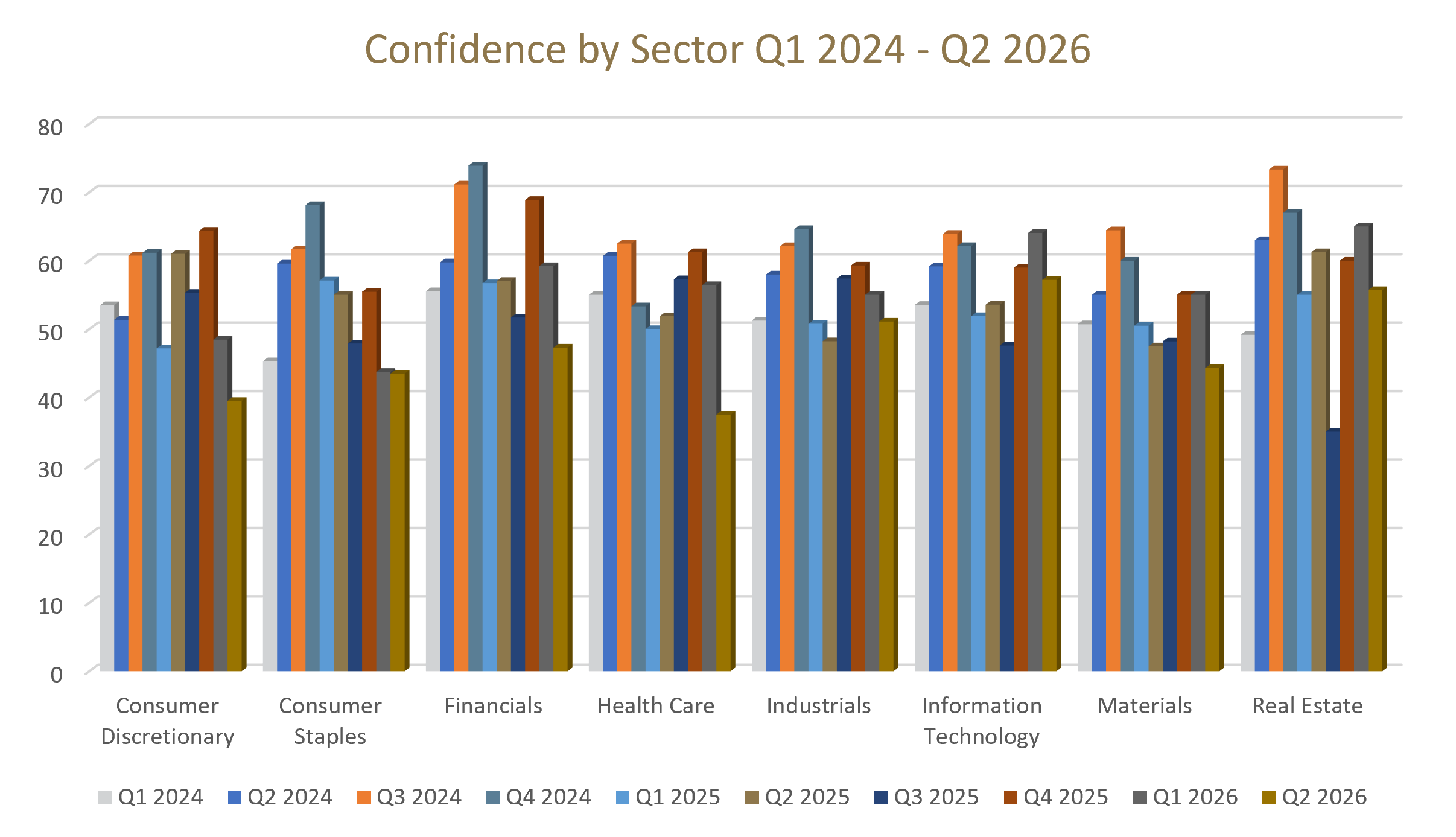
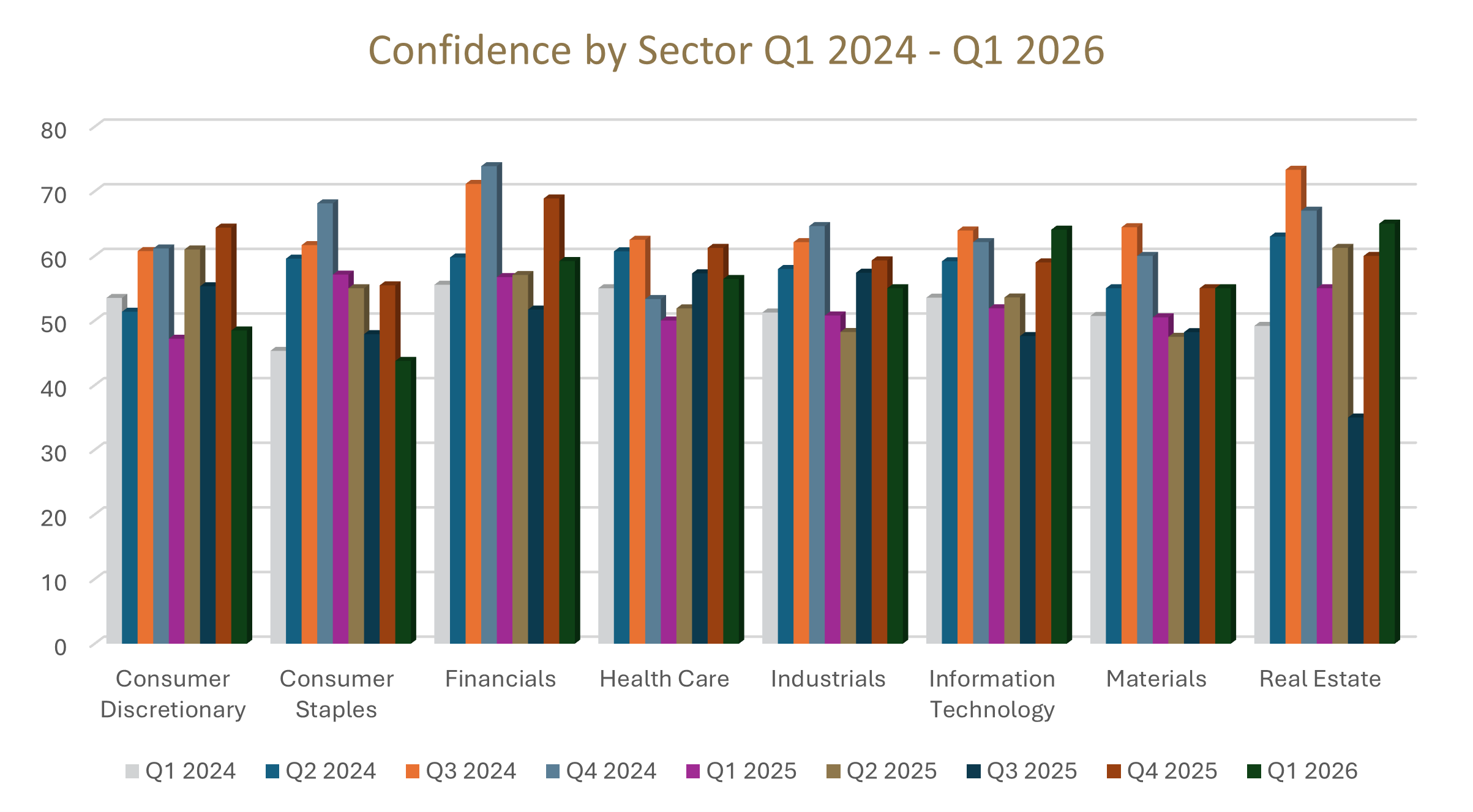
  • Technology leads sectoral gains: Information Technology rose to 64.1 (+5.1 points), driven by widespread AI adoption and digital transformation.
  • Real Estate rebounds strongly: Real Estate climbed to 65.0 (+5.0 points), the quarter’s top performer, on improved funding conditions and renewed residential demand.
  • Consumer sectors under pressure: Consumer Discretionary fell sharply to 48.5 (−15.9 points) and Consumer Staples to 43.75 (−11.75 points), weighed down by inflation, petrol price spikes, and weakening disposable income.
  • Geopolitical and fuel risks dominate: The Iran conflict and resulting oil price surges were cited repeatedly as threats to inflation, transport costs, and currency stability.

Geopolitical headwinds collide with domestic optimism

The Q1 2026 decline reflects a complex interplay of external shocks and domestic policy signals. CEOs remain wary of macro pressures: “The fuel shortage and rising prices in SA may force reconsideration of planned fuel levy hikes in the budget. High prices threaten to worsen inflation, increase transport costs, strain household and business budgets,” noted a CEO in Financials. Another in Industrials added: “Middle East conflict is a concern. Spike in oil price will fuel inflation globally”. A Real Estate CEO warned: “The Iran War must create huge uncertainty for the stability of the currency and borrowing costs”.

Yet optimism persists in pockets. A Financials CEO observed: “Some fiscal stability is being restored and a focus on economic growth is welcome. But political risks loom large, MK, EFF, and others make up an alarmingly high proportion of the vote”. A Health Care CEO celebrated: “Effect of GNU has kicked in!”. An Industrials CEO pointed to the VAT story: “VAT Thresholds increased are significant for SMEs”. A Financials CEO praised: “R1m to R2.3m VAT registration is very good for the economy!!”.

Critically, scepticism about “government promises” remains pervasive. A Financials CEO said flatly: “Promises do not help. We need action from the President”. A Materials CEO added: “Government is detached from business world”. An Industrials CEO captured the mood: “South Africa has a few green shoots supporting cautiously optimistic bias. SA has had not had good news for 10 years so any news is good news. But Fragile”.

Technology’s AI wave continues: “AI will be helping industries grow,” said a Consumer Discretionary CEO. An Information Technology CEO noted: “We expect improved business climate and more use of AI than before”. Another remarked: “The next several years will be an exciting time for the IT services industry… I am looking for equity investor so that I can advantage of the growth in the ICT industry”.

Sector snapshot: Divergent fortunes across industries

Real Estate (65.0, +5.0 points)

Confidence driver: Improved funding conditions and residential demand recovery
Investment stance: Optimistic on infrastructure and mixed-use projects
Cost pressure: Moderate; currency volatility a concern post-Iran escalation
Policy exposure: Sensitive to interest rate trajectory and municipal service delivery
Risk outlook: Watching geopolitical oil price impact on consumer affordability

Information Technology (64.1, +5.1 points)

Confidence driver: AI adoption accelerating across productivity and operations
Investment stance: Strong appetite for digital transformation and automation
Cost pressure: Skills shortages persist; hardware/software costs stable
Policy exposure: Broadly positive on infrastructure investment commitments
Risk outlook: Middle East conflict impact on global tech supply chains monitored

Utilities (61.25, +0.25 points)

Confidence driver: Improved infrastructure investment and regulatory stability
Investment stance: Cautiously optimistic; long-term capex planned
Cost pressure: Fuel price volatility threatens operational margins
Policy exposure: High; depends on budget execution and SOE reform
Risk outlook: Municipal capacity constraints and geopolitical fuel shocks

Financials (59.2, −9.7 points)

Confidence driver: Fiscal discipline welcomed; credit conditions stable
Investment stance: Selective; watching political risk and policy certainty
Cost pressure: Rising compliance costs; BEE regulations a drag
Policy exposure: Highly sensitive to tax policy and economic growth trajectory
Risk outlook: Political fragmentation and fuel-driven inflation

Health Care (56.4, −4.9 points)

Confidence driver: GNU stability; demand for health services resilient
Investment stance: Moderate; innovation ongoing
Cost pressure: Input costs stabilising; margins under pressure
Policy exposure: Trump USAID funding cuts impacting NGO-linked sectors
Risk outlook: Oil price impact on pharmaceutical and logistics costs

Industrials (55.0, −4.3 points)

Confidence driver: Infrastructure budget allocations; Transnet and Eskom improvements
Investment stance: Selective expansion; waiting for policy clarity
Cost pressure: Fuel, transport, and logistics costs elevated
Policy exposure: High; red tape, BEE compliance, and municipal rates cited
Risk outlook: Geopolitical fuel shocks and US trade policy uncertainty

Materials (55.0, 0 points)

Confidence driver: Commodity price stabilisation; export opportunities
Investment stance: Hold; watching global demand signals
Cost pressure: Elevated on transport and energy
Policy exposure: Moderate; Transnet and Eskom reforms critical
Risk outlook: Global market volatility; Middle East tensions affecting demand

Consumer Discretionary (48.5, −15.9 points)

Confidence driver: Weak; disposable income under pressure from inflation and tax bracket creep
Investment stance: Cautious; demand outlook subdued
Cost pressure: High; fuel, input costs, and margin compression
Policy exposure: Budget measures on discretionary spend watched closely
Risk outlook: Trump trade policy and Middle East war impact on sentiment

Consumer Staples (43.75, −11.75 points)

Confidence driver: Weakest sector; demand muted, input costs elevated
Investment stance: Defensive; efficiency focus
Cost pressure: Severe; fuel, logistics, and commodity input pressures
Policy exposure: Limited confidence in policy materialisation
Risk outlook: Iran-driven fuel price hikes and geopolitical alliances damaging trade

Click here to sign up to receive our quarterly questionnaire

Past Reports

Q4 2025

Confidence Rebounds
Majority of the CEOs Embrace AI

Read more

Q3 2025

Unemployment Crisis Deepens as CEO Confidence Plummets

Read more

Q2 2025

75% of CEOs Back SARB’s Inflation Target Cut as Confidence Flatlines

Read more

Q1 2025

95% of CEOs believe inefficient and wasteful government spending is the primary cause of South Africa’s budget deficit.

Read more

Q4 2024

70% of CEOs Cautiously Optimistic for 2025 GDP Growth at 1.5% Amid Slight Confidence Drop

Read more

Q3 2024

Merchantec CEO Confidence Index Climbs by 7% in Q3 as CEOs Anticipate a GDP Growth Rate of 1.5%

Read more

Q2 2024

Merchantec CEO Confidence Upswings by 13% in Q2 2024 Amid Economic and Political Optimism in South Africa

Read more

Q1 2024

80% of CEOs believe that the ANC’s support will fall below 50%

Read more

Q4 2023

Siya Kolisi’s Leadership Shines Amidst a 6% Drop in CEO Confidence

Read more

Q3 2023

Over Half of South African CEOs Express Doubts About BRICS Benefits, Reveals CCI Q3 Questionnaire

Read more

Q2 2023

Basic Resources Sector Leads the Way as CEO Confidence Improves

Read more

Q1 2023

100% of CEO’s support Merchantec’s CSR initiative while confidence drops to lowest level since 2019

Read more

Q4 2022

CEOs Confidence deteriorates as the year comes to an end

Read more​

Q3 2022

79% of CEO’s believe increased digital inclusion through expanded internet access for SA consumers will benefit their business 

Read more​

Q2 2022

75% of CEO’s think that the SA economy will dip into a recession over the next 12 months as CEO Confidence decreases by almost 20%

Read more 

Q1 2022

Basic Resources CEO’s Confidence at an all time high while inflation is set to breach SARB’s 3-6% range

Read more

In the Media

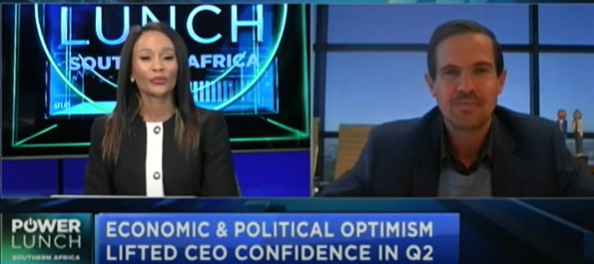
Q2 2024 interview with Fifi Peters from CNBC Africa
Q1 2024 interview with Gugulethu Mfuphi of KayaBiz
Q1 2024 interview with Zanele Morrison from CNBC Africa
Q3 2023 interview with Gugulethu Mfuphi of KayaBiz
Q2 2023 interview with Marcelle Gordon from eNCA
Q1 2023 interview with Gareth Edwards from eNCA