Merchantec Capital's CEO Confidence Index

About the CEO Confidence Index

The Merchantec CEO Confidence Index is a quarterly copyright report which collates the views of CEO’s of listed, large private and multinational companies in South Africa since 2009. CEOs are key players in the market and economy and are instrumental in influencing the future of Corporate SA. Therefore, by collecting CEOs views, the CEO Confidence Index provides a leading indicator of economic and market conditions as well as insight into how South African business leaders perceive the economy going forward.

The Index is unique in that it accounts for CEO Confidence according to sectors – making a good connection to Company prospects in the various sectors.

Merchantec Capital supports the Nelson Mandela Children’s Fund

Merchantec Capital has made a commitment to donate R110 to the Nelson Mandela Children’s Fund on behalf of each CEO who completes the questionnaire. Donations will go toward the operation and development of the Nelson Mandela Children’s Hospital, which provides specialised care to South Africa’s underprivileged children. Learn more about this initiative and the beneficiary by clicking here.

Our Latest Report

Unemployment Crisis Deepens as CEO Confidence Plummets

In Q3 2025, South African CEOs were asked whether they agreed with Capitec CEO Gerrie Fourie’s assertion that the country’s true unemployment rate may be closer to 10%, thanks to the informal sector, rather than the official 33.2%. The response was overwhelmingly skeptical, with only a quarter of CEOs supporting this view and the vast majority pushing back strongly.

Many CEOs acknowledged that the informal sector plays a vital role in providing livelihoods for millions, especially in a challenging economic climate. However, most leaders argued that equating informal, survivalist activities with formal employment “risks understating the severity of South Africa’s labour market crisis.” As one CEO put it, “The informal sector is significant, but 10% is too low. The crisis is deeper than the numbers suggest.” Another CEO highlighted the growing strain on the economy, noting, “Unemployment is growing at an alarming rate with company closures. The informal sector is large, but not enough to offset the crisis.”

Several CEOs emphasised that informal work rarely provides the stability, upward mobility, or economic contribution associated with formal jobs. One respondent warned, “Counting survivalist activity as employment creates a misleading picture of the economy.” Others pointed out that while the informal sector offers a crucial safety net, it does not address the underlying structural issues such as lack of skills development, limited access to capital, and persistent inequality that keep unemployment stubbornly high.

The consensus is clear: while the informal sector offers a lifeline for many South Africans, it does not fundamentally change the reality of high unemployment and underemployment. CEOs overwhelmingly believe that the country’s jobs crisis is far more complex and entrenched than a simple statistical adjustment can capture.

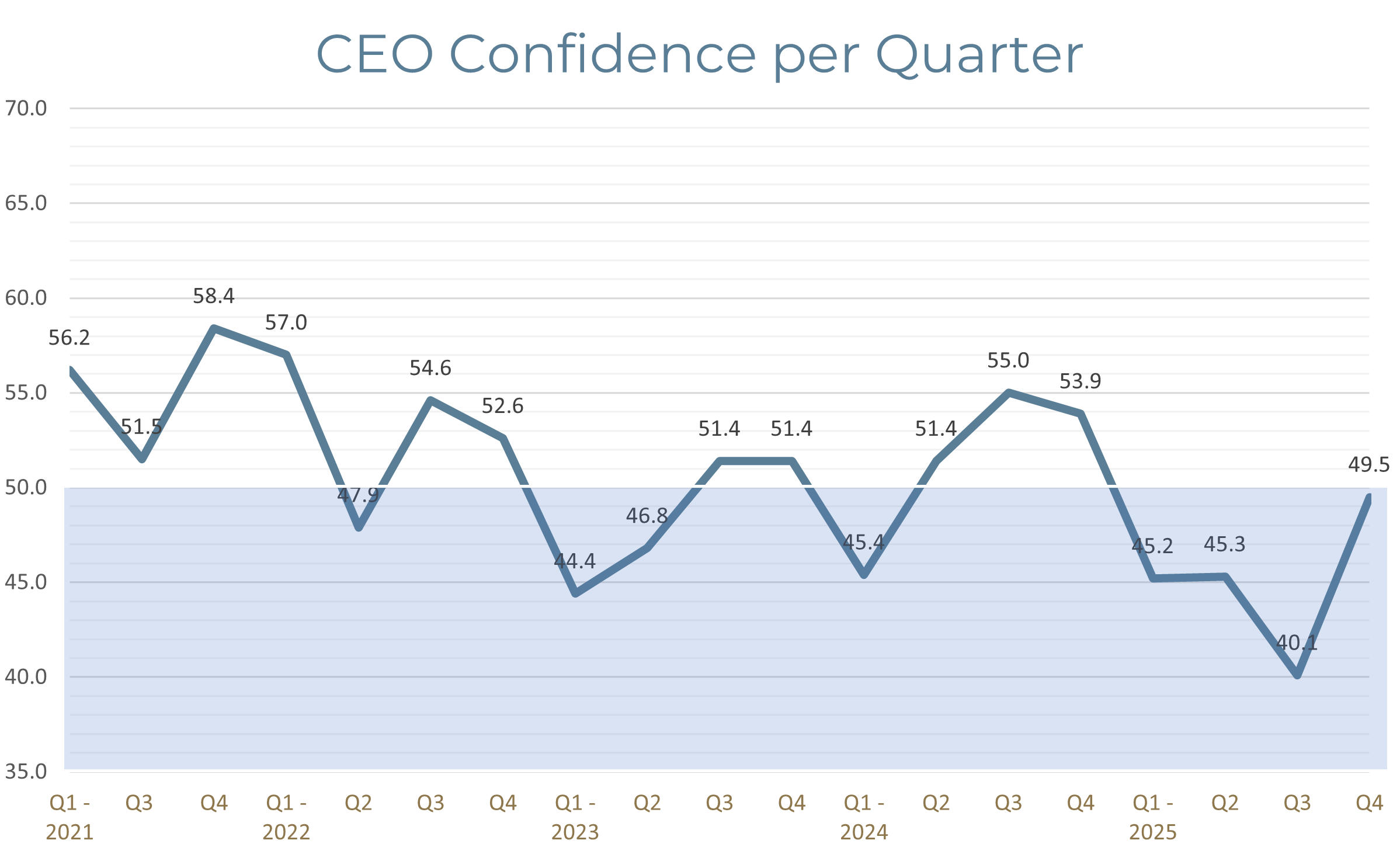
The Merchantec CEO Confidence Index plummeted to 40.1 in Q3 2025, down from 45.3 in Q2, marking the lowest sentiment since the pandemic recovery. CEOs cited a worsening macro environment, with persistent load shedding, weak consumer demand, and ongoing policy uncertainty. Many described the economy as “stuck,” with little sign of near-term improvement.

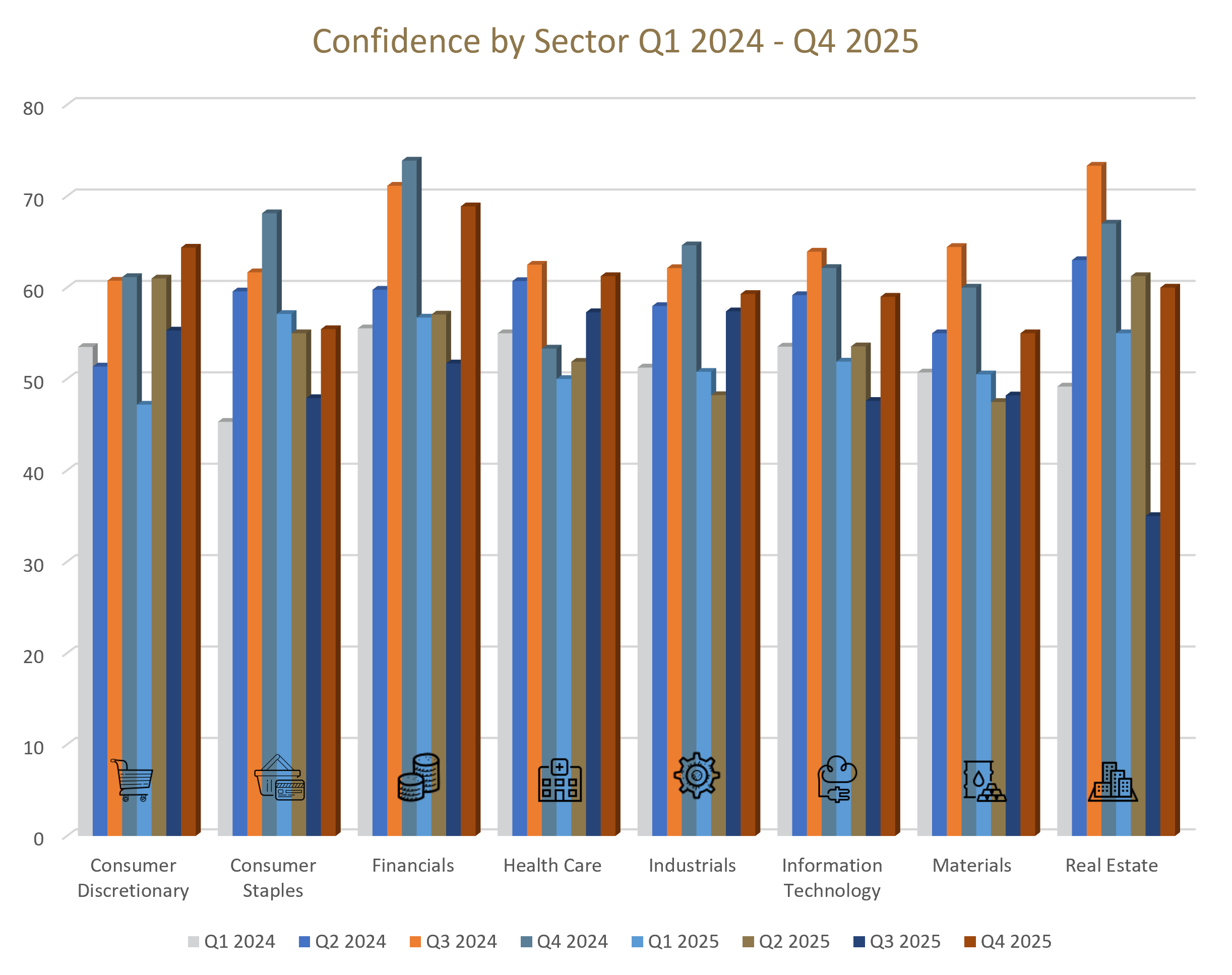
Industry growth sentiment remained subdued, as most sectors saw little to no progress and continued to face competitive pressures and shrinking margins. Company growth expectations softened, particularly in Consumer Staples and Real Estate, though Industrials and Health Care stood out for their resilience and sector-specific opportunities.

Access to capital remained challenging, especially for Real Estate and Utilities, where CEOs reported increased difficulty securing funding. Investment plans were largely on hold, with most leaders adopting a cautious stance and delaying major decisions until there is greater policy and economic clarity.

Sector-Specific Insights:

Consumer Discretionary experienced a notable decline, with the index dropping from 61.0 in Q2 to 55.3 in Q3. CEOs reported a slowdown in consumer demand and increased caution around discretionary spending, with ongoing concerns about cost-of-living pressures and market volatility.

Consumer Staples  also saw a decrease, with the index falling from 55.0 in Q2 to 47.9 in Q3. Leaders cited persistent cost pressures and subdued demand, though some noted early signs of stabilizing input costs. The overall outlook remains cautious.

Financials declined from 57.05 in Q2 to 51.7 in Q3. CEOs pointed to tightening credit conditions, regulatory uncertainty, and a more challenging lending environment as key factors behind the drop in confidence.

Health Care was a bright spot, rebounding from 51.88 in Q2 to 57.3 in Q3. CEOs highlighted renewed investment, sector-specific opportunities, and improved growth expectations, with increased demand for health services and innovation driving sentiment.

Industrials showed significant improvement, rising from 48.23 in Q2 to 57.4 in Q3. Leaders cited resilience, increased project activity, and better-than-expected demand in certain sub-sectors, with investment sentiment also improving as supply chain disruptions eased.

Information Technology  saw a decline, with the index dropping from 53.57 in Q2 to 47.6 in Q3. CEOs reported slower deal flow, increased competition, and delays in client decision-making, leading to a more cautious outlook.

Materials posted a slight gain, moving from 47.48 in Q2 to 48.2 in Q3. CEOs attributed the improvement to stabilsation in commodity prices and renewed export opportunities, though global market risks remain a concern.

Real Estate experienced the sharpest decline, with the index plummeting from 61.25 in Q2 to 35.0 in Q3. CEOs cited funding constraints, weak demand, and uncertainty in the property market as major challenges, resulting in a collapse in confidence.

Click here to sign up to receive our quarterly questionnaire

Past Reports

Q2 2025

75% of CEOs Back SARB’s Inflation Target Cut as Confidence Flatlines

Read more

Q1 2025

95% of CEOs believe inefficient and wasteful government spending is the primary cause of South Africa’s budget deficit.

Read more

Q4 2024

70% of CEOs Cautiously Optimistic for 2025 GDP Growth at 1.5% Amid Slight Confidence Drop

Read more

Q3 2024

Merchantec CEO Confidence Index Climbs by 7% in Q3 as CEOs Anticipate a GDP Growth Rate of 1.5%

Read more

Q2 2024

Merchantec CEO Confidence Upswings by 13% in Q2 2024 Amid Economic and Political Optimism in South Africa

Read more

Q1 2024

80% of CEOs believe that the ANC’s support will fall below 50%

Read more

Q4 2023

Siya Kolisi’s Leadership Shines Amidst a 6% Drop in CEO Confidence

Read more

Q3 2023

Over Half of South African CEOs Express Doubts About BRICS Benefits, Reveals CCI Q3 Questionnaire

Read more

Q2 2023

Basic Resources Sector Leads the Way as CEO Confidence Improves

Read more

Q1 2023

100% of CEO’s support Merchantec’s CSR initiative while confidence drops to lowest level since 2019

Read more

Q4 2022

CEOs Confidence deteriorates as the year comes to an end

Read more​

Q3 2022

79% of CEO’s believe increased digital inclusion through expanded internet access for SA consumers will benefit their business 

Read more​

Q1 2022

Basic Resources CEO’s Confidence at an all time high while inflation is set to breach SARB’s 3-6% range

Read more

Q2 2022

75% of CEO’s think that the SA economy will dip into a recession over the next 12 months as CEO Confidence decreases by almost 20%

Read more 

In the Media

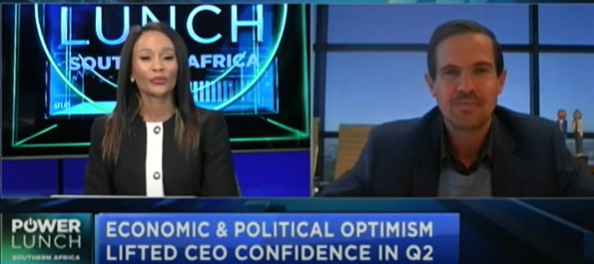
Q2 2024 interview with Fifi Peters from CNBC Africa
Q1 2024 interview with Gugulethu Mfuphi of KayaBiz
Q1 2024 interview with Zanele Morrison from CNBC Africa
Q3 2023 interview with Gugulethu Mfuphi of KayaBiz
Q2 2023 interview with Marcelle Gordon from eNCA
Q1 2023 interview with Gareth Edwards from eNCA